

50‑Seat Jets Are Driving Network Growth. Here's Why.
 24
24
)


Regional jets are essential to the U.S. domestic aviation ecosystem.
Although the narrative promoted by some turboprop manufacturers suggests otherwise, 50-seater jets are far from being phased out. In fact, 2025 has seen a surge in new 50-seat jet routes.
While ATR announced only one (1) new U.S. route in 2025 — one that we might add was never underserved — the regional jet footprint has quietly and decisively expanded across the North American network. The three largest U.S. carriers added dozens of brand-new regional jet-operated markets, proving that the demand for fast, reliable, right-sized jet operations is not only alive, but accelerating.
CRJ GROWTH IN 2025: A MARKET REALITY CHECK
2025 was a growth year for the CRJ family of aircraft. Far from disappearing, CRJ Series aircraft are used to expand regional connectivity from major hubs to underserved communities across North America, strengthening the hub-and-spoke network.

Year-over-year OAG market data tells a clear story: in 2025, over 20 new CRJ Series routes were added that didn’t exist in 2024, including 12 using 50-seater aircraft.
In 2025, Delta Air Lines added two new routes from Minneapolis (MSP) using the CRJ550, while United Airlines added 10 new city pairs from their hubs in Chicago (ORD), Denver (DEN) and Houston (IAH) using the CRJ200.
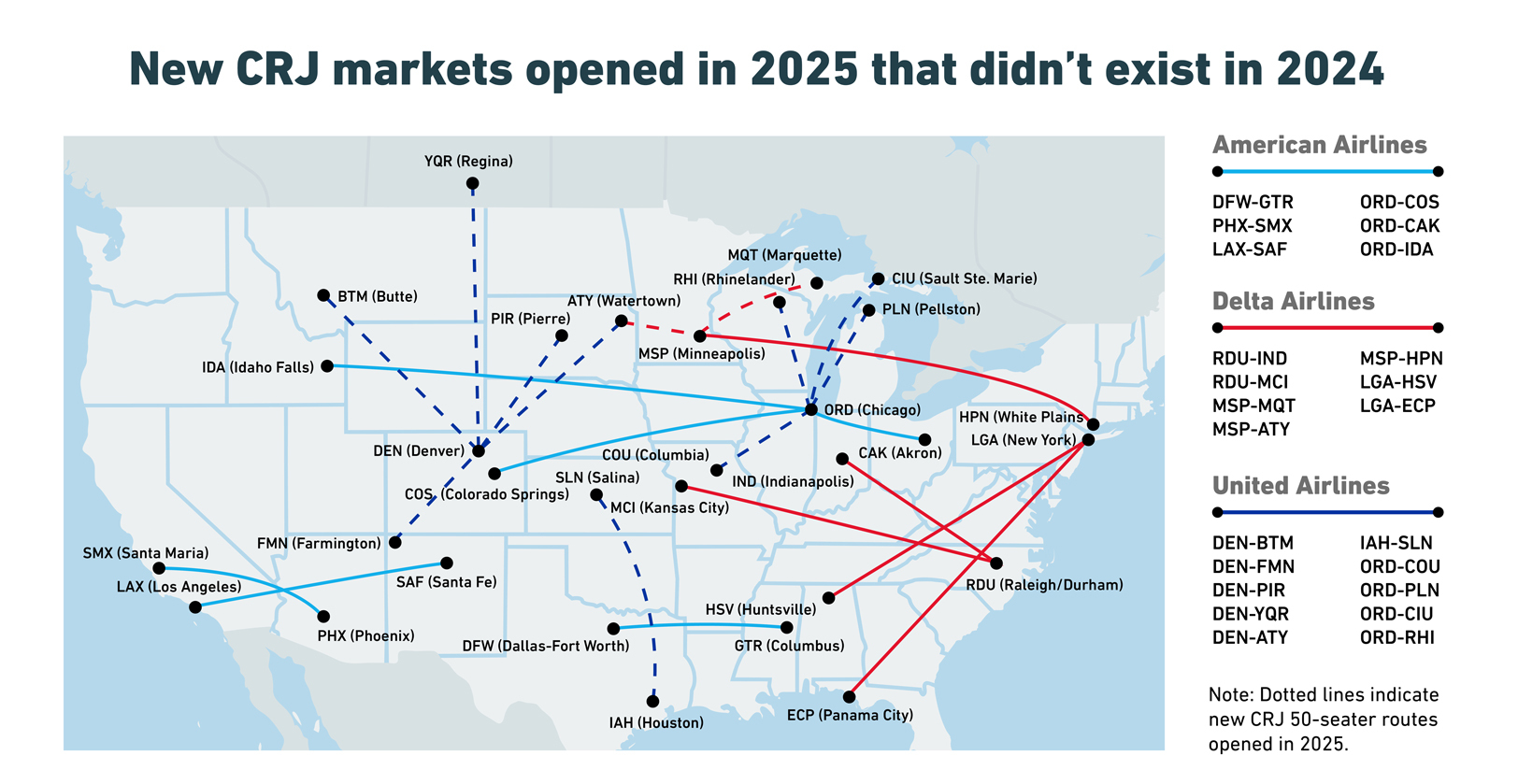
When looking at all the new CRJ routes added in 2025, it’s also interesting to highlight the flexibility of regional jets, making it economical to operate on distances ranging from a short 168 nautical miles (MSP-ATY) to as long as 1,068 nautical miles (ORD-IDA).
Regional Jets are still winning today because of their reliability, their right-sized economics in thin markets, and their speed advantages in hub-and-spoke operations. The 2025 market expansion reflects continued investment in the platforms and the enduring value of small regional jets.
- Log in to post comments